

CheerLights turns 15 this November! In 2011, I wanted to connect my Christmas lights to other people’s lights. If mine turned blue, theirs could turn blue too, wherever they were. I didn’t know that one idea would give me 15 years of things to learn and people to meet. Along the way, I got to share it with my son, George, as we made projects together.

I introduced CheerLights at HackPGH, a makerspace in Pittsburgh. A few people joined in, and then Matt Richardson wrote about the project for MAKE. Suddenly, people I had never met were building displays that followed the same color as mine.
Five years ago, I shared some of those projects in my tenth-anniversary post. Looking through the photos again, and gathering stories for a CheerLights book, has reminded me how much of this project belongs to the people who joined it.
One Color, All These Possibilities
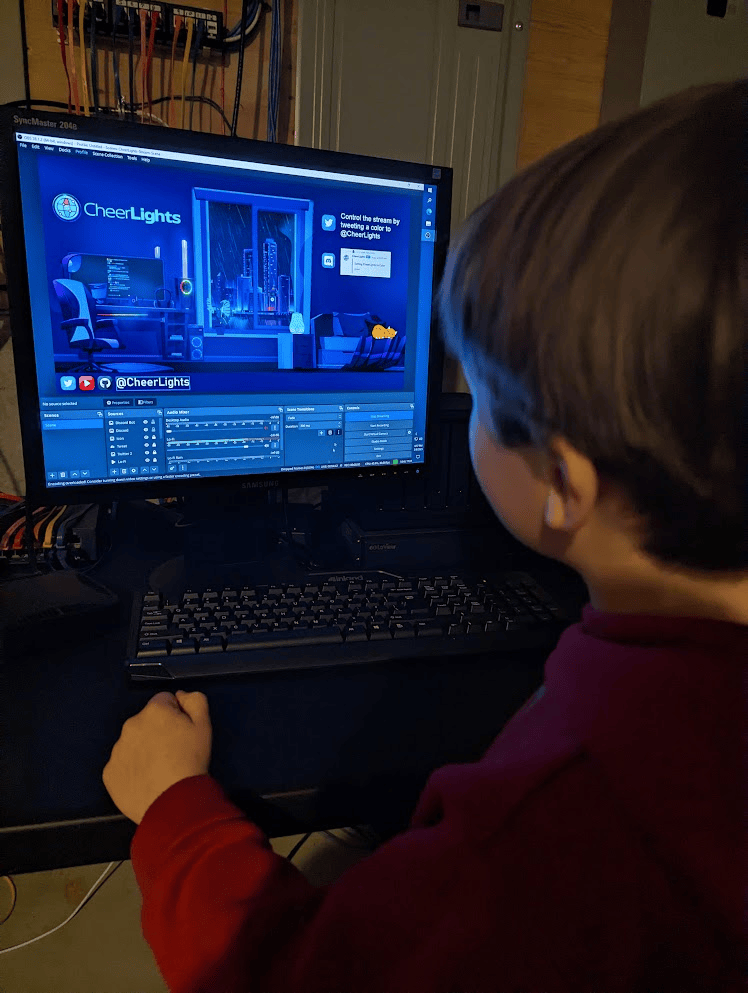
Over the years, people have connected Christmas trees, hats, buildings, browser widgets, and even a dinosaur. Dr. Lucy Rogers put CheerLights on a plaster cast. Leif Bloomquist made a blocky Christmas tree on a Commodore 64. George and I have put lights inside Halloween pumpkins and played with the interactive livestream together.
You know the saying: when you have a hammer, everything looks like a nail? That’s how I’ve used CheerLights. I’d see something at RadioShack, on Kickstarter, or in a thrift store and think, “Could I CheerLight that?”
Sometimes the next project stopped being about a color at all. Someone remixed the idea into a desk display showing snowfall at his favorite mountain. My On Air light read a ThingSpeak channel for webcam status instead of a CheerLights color. Once I knew how to read a color and display it, I could try the same process with other information.
Thank You for Keeping the Lights On
There have been some difficult stretches. When we lost Twitter API access, the way many people had been changing the color stopped working.
Jeff Lehman deserves a massive thank-you. Jeff created our Discord bot and helps manage the server. He had already built the bot before the Twitter transition, and he helped tremendously when things felt bleak. He’s kept showing up to maintain the bot and help care for the community. You can find his work on GitHub as n8acl and on his website. Thank you, Jeff, for helping keep CheerLights alive and moving forward.
Today, you can join our Discord server to request a color and share what you’re making.
The People Who Made It Their Own
Working through the project’s history keeps bringing me back to the people who shared their time and ideas. I want to thank them here, knowing this list will never capture everyone.
Andy Stanford-Clark has helped connect people across the pond through a shared colour. Yes, colour. I added that spelling as an MQTT topic for Andy and the community he helped build in the UK. From his cube-shaped CheerLights “Orb” to our work on Node-RED and MQTT, Andy has been a generous collaborator and supporter.
Dr. Lucy Rogers showed how personal and playful a connected light could be. Her CheerLights cast, light-up shoes, and snowman and Death Star diffusers made people curious. Her Raspberry Pi and Node-RED orb tutorial helped them try it themselves. Lucy, thank you for making it your own and bringing others along.
Becky Stern brought CheerLights to new builders through her videos and tutorials, including Your First CheerLights Circuit. Her work connects electronics with craft, materials, and wearable projects. Thank you, Becky, for teaching people how to get started and giving them room to be creative.
Kevin McAleer brought 3D printing, electronics, and MicroPython together in his CheerLights Christmas bauble. He shared the Christmas Cheer code and files so others could build along. Thank you, Kevin, for showing people how to build their own.
John Milner shared Arduino CheerLights examples, including his work using MQTT to keep multiple displays following the color. His examples give the next builder code to read and change. Thank you, John.
Andy Leer and the HackPGH community were there at the beginning. Matt Richardson helped the project reach people through that first MAKE story, and Jeff Highsmith later built CheerBot, a roaming robot that could find a color and ask CheerLights to share it. Andy Piper helped with the work behind the scenes, including handling color mentions in tweets. Thank you for helping an idea from a makerspace reach so much further.
MathWorks has been a huge supporter of my work and CheerLights. Christopher Staples and Robert Mawrey built campus displays, and the livestreams let people elsewhere see the lights change. Seeing that support extend from large installations to sharing the little robot light I made for George’s nursery meant a lot to me.
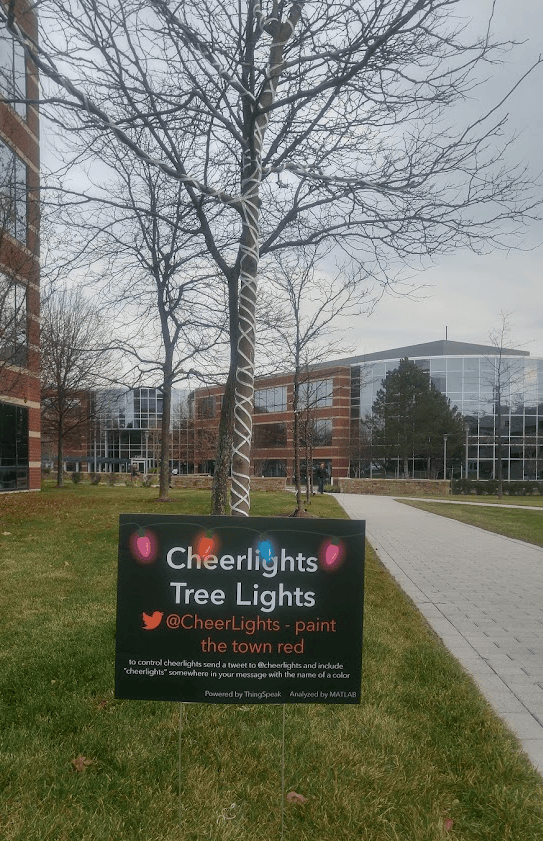
And thank you, everyone, who shared a build, wrote instructions, contributed code, taught a workshop, or helped someone troubleshoot their first light or even their first step learning IoT concepts.
Still Making
CheerLights will stay a deeply personal project for me. I’ll keep using it to explore new technology and make things with George. I’m also working on a book to collect the stories and help people use CheerLights as a starting point for their own projects.
And maybe, one day, the Sphere in Las Vegas will follow the CheerLights color for a day. Hint, hint. Just putting that out there.
For now, you don’t need a building full of lights to join us. You can watch the livestream, learn how CheerLights works, or join the conversation on Discord. If you’ve already built something, share it with us. I’d love to see what you’ve made, and so would the person looking for their first project.
It has been a privilege to share this maker journey with you. Thank you for 15 years of CheerLights.